
I see it constantly. A founder who has built a real business — real revenue, real clients, real results — decides it is time to grow. They hire a marketing agency. They run more ads. They post more content. They add more channels. And the results do not move the way they should.
The instinct is to try something different — new creative, new targeting, new platform. But the problem is not the marketing. The problem is what the marketing is built on.
Before scale comes clarity. And without clarity, more marketing just means more noise.
More marketing does not fix a positioning problem. It amplifies it. Every dollar you spend on a brand that is not clearly positioned is a dollar that teaches the market to be confused about you.
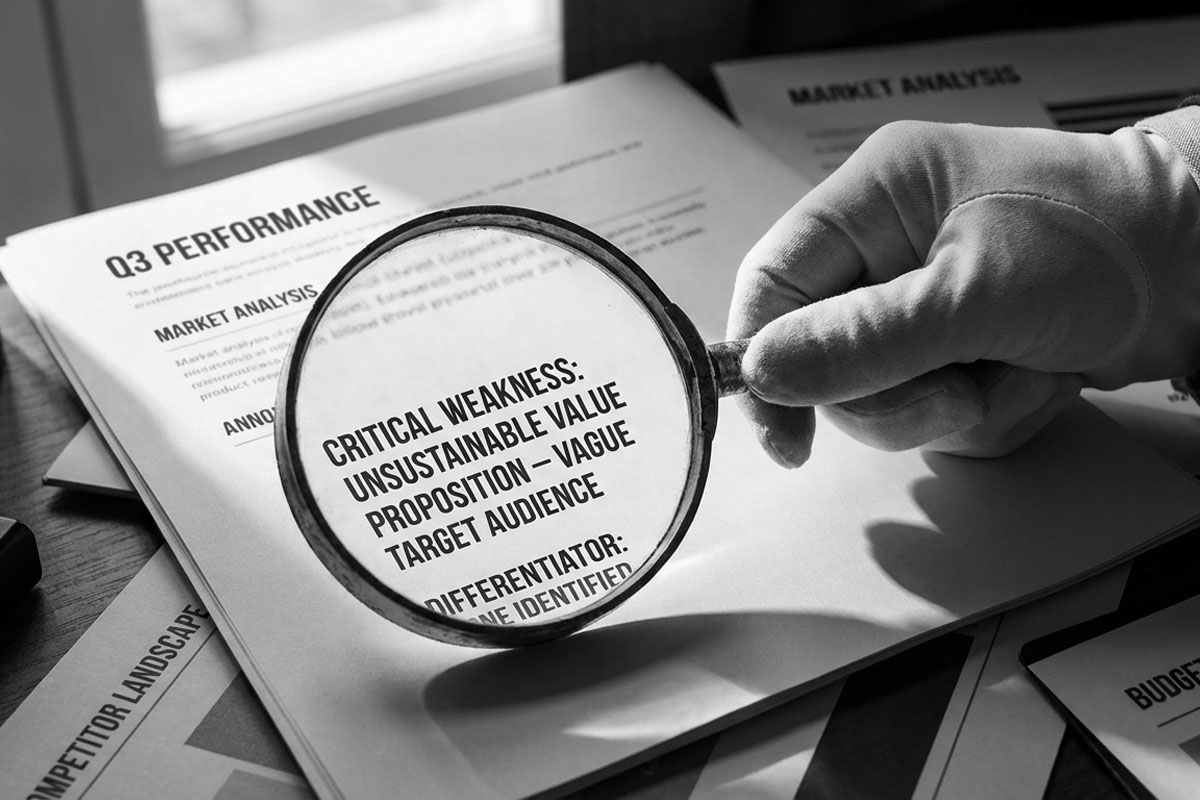
Weak positioning is not always obvious from the inside. Most businesses that have it feel like they are doing fine — they are getting clients, they are growing, they have a track record. What they do not see is how much harder everything is working than it needs to be.
Here is what weak positioning looks like in practice:
If two or more of those are true, you have a positioning problem. And adding more marketing spend will make that problem more expensive, not smaller.
Positioning is not a tagline. It is not a mission statement. It is not the language on your about page. It is a strategic decision about where you choose to compete, who you choose to serve, and what you choose to be known for — and then making every part of your business reflect that decision consistently.
When positioning is clear, everything downstream becomes easier. Your ads know exactly who to target and what to say. Your website knows who it is talking to and what problem it is solving. Your sales process knows how to qualify and disqualify quickly. Your team knows how to describe the business without asking you first.
When positioning is weak, none of those systems can operate efficiently — no matter how much budget or effort you pour into them.
After working with growth-stage businesses across industries, I have found that a strong position always has four elements:
1. A defined buyer.
Not "small businesses" or "professional services firms." A specific person in a specific situation with a specific problem. The more specific you are about who you serve, the more clearly your brand speaks to the right people — and the more confidently the wrong people self-select out.
2. A named problem.
Not a category description of what you do — a specific articulation of the problem you solve and why it is worth solving now. Buyers do not search for services; they search for relief from problems. Your positioning needs to name the pain before it sells the cure.
3. A defensible difference.
Not "quality work" or "great service" — those are table stakes, not differentiators. A defensible difference is something that is true about you and not easily replicated: your methodology, your specialization, your track record, your point of view. It has to be specific enough to be believed and distinct enough to matter.
4. A proof structure.
Claims without evidence are just opinions. Your positioning needs to be backed by specific, credible proof — case results, client outcomes, industry recognition — that makes the claim believable before a prospect ever gets on a call with you.
Positioning is not what you say about yourself. It is what people believe about you before you say anything. Your job is to engineer that belief — deliberately and consistently.
The first step is not rewriting your website. The first step is getting clear on the strategic foundation — and that requires an honest audit of where you actually are versus where you need to be.
At Abstract Creative, we call this a Brand Gap analysis. We look at your current position, your target buyer, your competitive landscape, and the gap between how you are currently perceived and how you need to be perceived to win the clients you are trying to attract. It is the first step in the ICON Method — the brand transformation framework we use with every growth-stage client.
From there, we build the positioning architecture — the foundational decisions that every piece of downstream marketing is built on. Website, ads, content, sales decks — all of it flows from that foundation.
If you are spending money on marketing and not getting the results you expect, do not buy more marketing. Get clear first. Then scale what is working. Most growth-stage firms discover their brand starts breaking down between $500K and $5M — precisely because they scaled before the foundation was solid.
Foundation Service
The Foundation service locks your market position, defines who you serve, and builds the strategic base that every marketing dollar runs on.
A 30-minute strategic conversation about your positioning, your competitive landscape, and the clearest path to differentiation.
Client Results
“Efren didn’t just design assets — he built a cohesive brand system that elevated how my business shows up everywhere. We’re regularly asked where our branding came from.”
Sebastian Millan
CEO, TMS — Tools, Materials & Supplies
“He has a rare ability to anticipate client needs proactively, which made the collaboration seamless and efficient. His attention to detail is evident in every deliverable. I highly recommend his services.”
Cathy Torres
CEO, Stamped Passport Society
“This wasn’t just branding — it was business transformation. Website, automation, first campaign — now we feel unstoppable. Our close rate went up immediately.”
Derrick Hendricks
CMO, Grammas

Written by
Founder, Abstract Creative — Brand Transformation Studio, Houston TX
Efren works with professional services firms between $500K and $5M to install the brand infrastructure they need to scale without drift — positioning, architecture, conversion systems, and growth channels built in the right sequence.
Free Download
The complete walkthrough of all four brand pillars — with assessment questions and failure patterns for each. Free, no fluff.
Get the Free BlueprintNot sure where your brand stands? The free assessment identifies your weakest pillar in 5 minutes.
Take the Free Assessment →