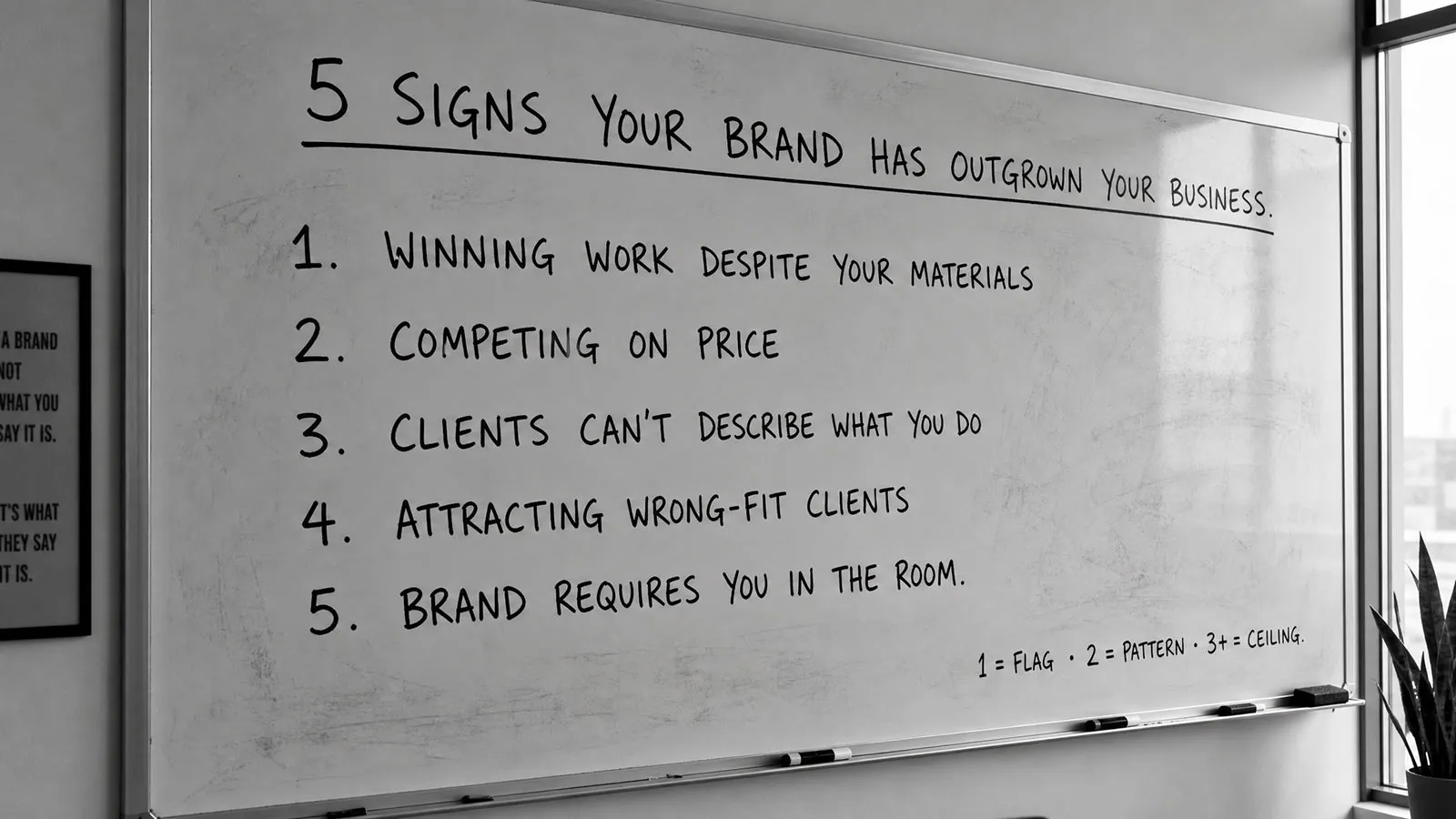
There is a growth stage where execution outpaces identity.

It does not happen at $50 million. It rarely happens in the first year.
It happens in the middle — somewhere between proving the model and building the machine. Between the founder closing every deal and the organization needing to close deals without them.
This is the stage where most brands quietly break. Not because the market shifted. Not because the product failed. Because the brand was never built to operate at scale — it was built to operate around a person.
Your brand was designed for a version of your business that no longer exists.
The Founder-Brand Trap
In the early stages, the brand is inseparable from the founder. Your reputation is the positioning. Your relationships are the pipeline. Your judgment is the quality control.
This is not a weakness — it is how early-stage companies survive. Founder-led brands move fast, feel authentic, and close deals through trust that no marketing budget can manufacture.
But there is a ceiling built into that model.
The moment you start hiring senior leaders, pursuing accounts that do not know you personally, or trying to build a team that can represent the company without you in the room — the cracks appear.
- Your leadership team communicates the value proposition differently.
- Your sales team improvises messaging because there is no documented standard to follow.
- Your marketing spend underperforms because the positioning was built for a founder in conversation, not a brand operating independently across channels.
The fracture is not a failure of talent. It is a failure of infrastructure.
Execution at scale requires a brand that can operate without you. Most brands at this stage cannot.

This Is Not a Marketing Problem — And Hiring an Agency Will Not Fix It
The executive instinct at this stage is to accelerate. More budget. Better agency. Bigger campaign. It is the wrong sequence.
No media spend, no content strategy, and no rebrand will generate consistent returns on top of a foundation that was never formally built. Agencies are equipped to amplify a brand — not construct one from scratch while simultaneously running campaigns.
The problem is not the talent you are bringing in. The problem is what you are asking them to build on. More marketing does not fix a positioning problem. It amplifies it.
What Brand Infrastructure Actually Means at the Executive Level
Brand infrastructure is not a creative project. It is an operational one. It is the system that allows your organization to communicate consistently, position accurately, and show up with authority — whether the touchpoint is a board presentation, a sales proposal, a LinkedIn post, or a new hire's first client call.
It has four components, and they are sequentially dependent:
Positioning clarity.
Who you serve, what problem you solve, and why your organization — not the category — is the right answer. Without this, every downstream decision becomes a negotiation.
The language framework that carries your positioning across every audience, channel, and context. This is what allows a senior leader, a sales director, and a marketing manager to say different things that still sound like the same company.
Visual system.
Design that communicates authority and trust before a word is read. Not aesthetic preference — strategic signal.
Operational standards.
Documented guidelines that remove interpretation from execution. The brand should not depend on institutional memory. It should be codified.
When these four are built and connected, the brand becomes infrastructure — something the organization runs on, rather than something the founder personally maintains.
The Leaders Who Scale Past This Stage Share One Decision
Across organizations that successfully cross this inflection point, the pattern is consistent. They stopped treating brand as a creative function and started treating it as a strategic one.
They locked positioning before pouring budget into marketing. They built messaging architecture before hiring a communications team. They codified the visual system before commissioning a redesign.
The sequence is not glamorous. It does not make for a compelling conference keynote. But it is the operational difference between organizations that scale with consistency and those that grow into incoherence — louder, busier, and increasingly difficult for the market to understand.
You do not need a bigger brand. You need a more precise one.
Where Senior Leaders Should Start
If your organization is at this stage — and you recognize the symptoms: inconsistent messaging across teams, marketing spend that is not converting, a brand that feels different depending on who is speaking — the starting point is not a rebrand.
It is an honest audit of the foundation. Not the aesthetics. The positioning. The message architecture. The brand's ability to perform without the founder or senior leadership in every conversation.
That audit is the work. Everything built after it — through the ICON Method or any rigorous brand transformation process — is faster, more effective, and significantly less expensive to maintain.