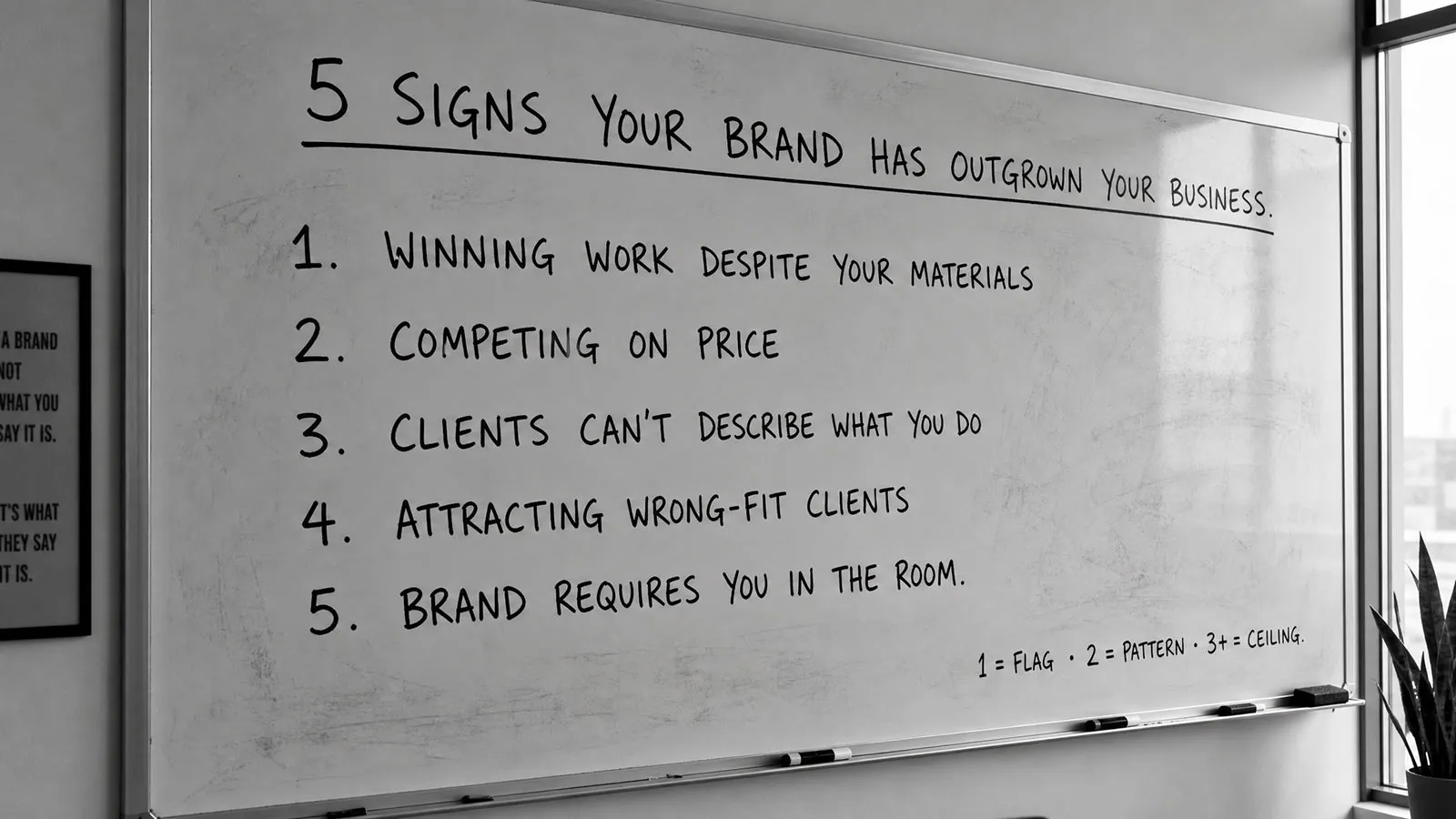
The most honest diagnosis most founders will never give themselves.
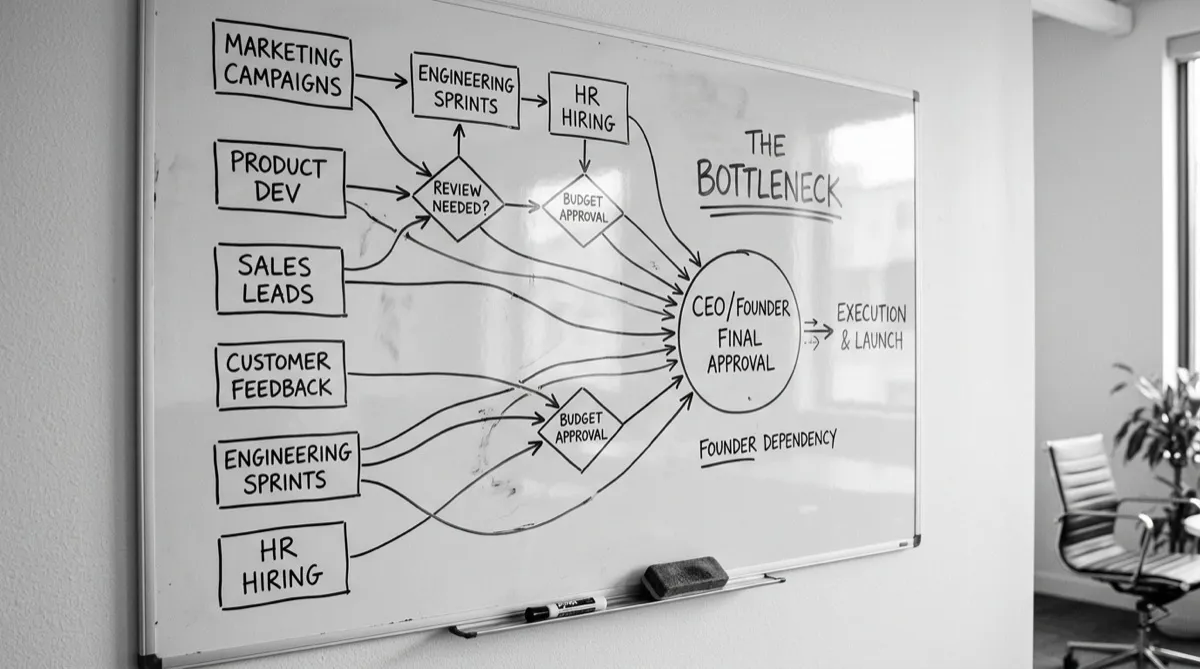
The business is growing. Revenue is up. The team is larger than it has ever been. And yet, somehow, every critical decision still routes back to you.
The proposal needs your review. The pitch needs your voice. The positioning question — the one your marketing lead should be able to answer at 9 a.m. on a Tuesday — still requires a conversation with you before anyone moves.
This is not a sign that you are indispensable. It is a sign that the infrastructure was never built.
If your brand only works when you are running it, you are not the founder. You are the ceiling.
The Moment It Becomes Undeniable
There is a specific moment — most founders recognize it in retrospect — when the dependency becomes visible. It is not a single event. It is the accumulation of small signals that arrive too close together to ignore.
A senior hire cannot articulate your differentiation in a prospect meeting. A marketing campaign launches and reads like it came from a different company than the one on your homepage. A sales lead goes cold because the follow-up lacked the authority that only lands when you are the one sending it.
Each incident is explainable in isolation. Together, they point to the same root: the brand lives in your head, and your head has a throughput limit.
The growth stage where brands break is rarely caused by a bad market or a product failure. It is caused by an organization that scaled its headcount without scaling its infrastructure. The brand was never extracted from the founder's judgment and converted into a system the organization could operate on.

What Needs to Come Out of Your Head
Extracting a founder-dependent brand is not a creative exercise. It is a documentation and architecture exercise. Four things, specifically, need to be pulled from institutional knowledge and converted into operational systems:
Voice and tone.
The way you speak about your company — the register, the specificity, the things you never say — exists as a felt sense in your mind. It is not transferable through osmosis. It needs to be defined, with examples, so that anyone producing content under your brand is working from a standard rather than a guess.
Positioning.
Who you serve, what problem you solve, and why your organization — not the category — is the right answer. If this answer changes depending on who is in the room, or who is answering the question, you do not have a positioning. You have a talking point. Those are not the same thing.
Message hierarchy.
The sequenced framework that determines what gets said first, what supports it, and what gets omitted entirely depending on audience and context. Your team should not be improvising this in real time. Message hierarchy is what allows a sales director, a marketing manager, and a senior leader to say different things that still sound like the same organization.
Visual standards.
Design decisions are not self-evident to people who were not present when they were made. Without documented standards — color, typography, layout principles, what the brand does not do — every new asset becomes a negotiation. The organization produces materials that are technically on-brand by intuition and systematically inconsistent in practice.
These four components are not a rebrand. They are the codification of decisions you have already made — extracted, documented, and converted into brand architecture that operates without requiring your input on every execution.

Why This Is a Brand Infrastructure Problem, Not a Management One
The instinctive response to founder dependency is an organizational one. Hire a VP of Marketing. Bring in a communications director. Delegate the brand decisions downward and trust that the talent will figure it out.
This does not work when there is no system to delegate into. Talent without infrastructure does not produce consistency — it produces variation with higher production value. The materials look better. The strategy behind them is still improvised.
The difference between a brand that exists and a brand that generates revenue is sequence. Infrastructure comes before execution. Positioning comes before messaging. Architecture comes before creative. When those are reversed — when execution begins before the foundation is built — the founder ends up as the correction mechanism for every output the team produces.
That is not leadership. That is a loop. And it compounds. Every quarter the foundation is missing is a quarter the organization gets better at producing inconsistency at scale.
Hiring better people does not fix a missing system. It just gives more people access to the gap.
The Diagnostic Question
Before engaging any process — before a rebrand, before a new agency, before a messaging overhaul — there is one question that clarifies the actual problem.
What is the one thing in your business that only you can currently answer?
If the answer involves positioning, messaging, or how the brand should show up in a given situation — that is the starting point. Not because you should no longer have an opinion, but because your opinion needs to be converted into a standard that the organization can act on without you in every conversation.
The organizations that scale past this stage share a consistent pattern. They stopped treating the founder's judgment as the brand's operating system and started treating it as the source of a documented standard. One is a dependency. The other is infrastructure.
The ceiling is not your market. It is not your team. It is the gap between what exists in your head and what has been built into a system the organization can run on when you are not in the room.
That gap is addressable. But it requires treating it as the infrastructure problem it is — not a management problem, not a hiring problem, and not a creative one.